
1. Structural Overview & Material Physics
In early-generation companion hardware, many users—and even our team during initial testing—assumed that the oral cavity and tooth structures were made of rigid polymer materials like hard PVC or resin. However, after conducting tensile and durometer testing on recent high-end head sculp builds, the actual material tuning tells a very different story.
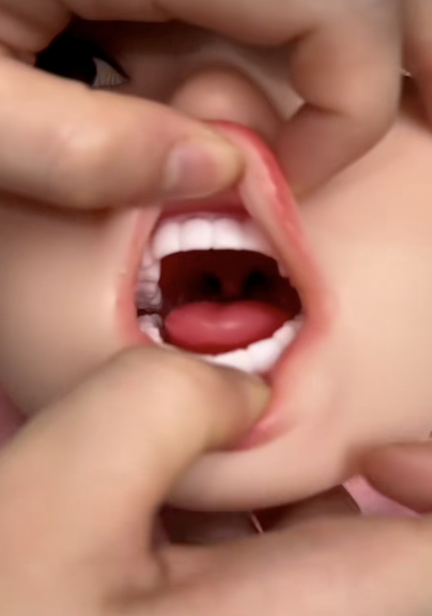
- Shore Hardness & Elasticity: The internal oral cavity (including gums and tongue) utilizes ultra-low durometer medical-grade TPE or liquid silicone rubber (LSR). The teeth are not rigid internal frames; instead, they are engineered from soft, highly elastic vulcanized polymers.
- Deformation Recovery: When subject to pressure or lateral tension, these soft teeth exhibit an exceptionally high shape recovery rate. This maintains crisp facial contour definition while completely eliminating the risk of mechanical impact or harsh contact.
- Internal Ergonomics: The vocal/oral depth is calibrated according to human ergonomic standards, delivering a highly satisfactory physical fit in terms of both cavity length and volume.
2. Pigmentation & Surface Engineering
The lip area on modern head structures no longer relies on basic surface paint. Instead, it employs multi-layer anatomical pigmentation:
- Base Pigmentation: Color palettes span a wide range—from natural nudes and corals to deep rubies.
- Color Migration Resistance: Premium head sculp lips use in-mold layered pigment infusion rather than simple top-coat painting. This ensures high durability against fading or pigment migration during routine cleaning, handling, and powdering.
3. Interface Mechanics & Stress Limits
Regarding the mechanical stability of modular head assemblies, our stress testing highlighted crucial physical boundaries:
- Connector Mechanics: Standard M8/M10 threaded rods or quick-release ball joints remain the industry standard.
- Joint Clearance Expansion: Because the silicone/TPE around the neck peg interface possesses elastic damping, applying excessive force or extreme angles can cause temporary joint clearance or slight loosening.
- Operational Boundary: To prevent thread stripping or deformation of the internal tension springs inside the neck skeleton, avoid applying excessive shear force or high torque during articulation. When adjusting head poses, always anchor the base of the neck skeleton with one hand while supporting the head sculpt with the other to maximize connector longevity.
4. Summary
Modern oral cavity engineering achieves a solid balance between visual realism and material ergonomics. The soft, high-elasticity teeth and cavity design significantly improve handling safety and comfort, while keeping neck interface stress limits in mind remains key to long-term hardware durability.